
Guides Europe

Europe · Orientation · 4 min read

The system lowers the risk. The address still decides.

European franchising is large, regulated and unusually well documented. That documentation is worth reading closely, because it shows exactly which risks a franchise agreement removes — and which one it hands straight back to you.

Published · Published industry and statutory figures, restated with sources. Not legal, financial or investment advice.

  • Franchising in Europe
  • Franchise statistics
  • Franchise failure rate
  • France
  • United Kingdom

Scale

A quarter of the world's franchising happens here.

More than 24,600 franchise systems operate upwards of 180,000 individual outlets across Europe and employ over 2.6 million people — roughly a quarter of the global franchise market. This is not an emerging channel; it is a mature one with national federations, a shared code of ethics and statutory disclosure regimes in half the member states.

Two national markets anchor the rest. France runs 2,089 franchise networks across 90,588 points of sale, generating €88.64 billion in annual commercial turnover. The United Kingdom supports 1,009 systems operating 50,421 units, contributing £19.1 billion to GDP with an employment base of 770,000.

Scroll sideways to see all columns

Published federation and industry figures, restated. These are market statistics, not this platform's measurements.
MeasureEuropeFranceUnited Kingdom
Franchise systems24,600+2,0891,009
Outlets / points of sale180,000+90,58850,421
Economic contribution—€88.64bn turnover£19.1bn GDP
Employment2.6m+—770,000

Federations count differently — turnover is not GDP contribution, and a point of sale is not always a separate legal operator. Compare a country against itself over time rather than against its neighbour.

Risk

50% against under 6%.

Across European markets, roughly 34% of independent business startups fail within two years, and about half are gone by the end of year three. Long-term commercial failure rates inside accredited franchise systems run below 6%, with annual default documented at 0.5%, and national surveys consistently find 89% to 93% of mature franchise units trading profitably.

The gap is not luck. It is the transfer of a tested operating system: a format somebody has already run at a pilot unit, supply channels that exist, software that works, and central purchasing that pulls cost of goods 15% to 30% below what an independent merchant can negotiate alone. European retail banks price that difference in too, underwriting franchise applications under dedicated programmes with senior debt reaching 70% of capital.

  • Independent startups: ~34% fail by year two, ~50% by year three
  • Accredited franchise systems: long-term failure below 6%, annual default 0.5%
  • Mature franchise units reporting profitability: 89% to 93%
  • Central purchasing cooperatives: 15% to 30% off baseline cost of goods

The residual

Everything except where you put it.

Read the list of what the franchisor supplies — format, know-how, training, supply chain, national marketing, field support — and then notice what is missing from it. In approximately 90% of European franchise networks the franchisee assumes the entire capital expenditure to construct and commission the store, signs the lease, and carries the operating expense. The franchisor licenses the system and oversees compliance; it avoids direct property liability.

So the risk the agreement does not remove is the one attached to a postcode: whether the catchment around this unit, at this rent, on this street, supports the format. A nine-year French commercial lease or a ten-year German fixed term makes that a decision you live inside for a long time. It is also the only major input to the model that nobody else in the transaction is paid to get right for you.

Where this platform fits

We work on the variable nobody else underwrites.

MapMyFranchise does not sell a franchise, a lease or an opinion about a brand. It compares the micro-markets inside one city on the terms a franchise decision actually turns on — catchment, competition, modelled rent and modelled returns — and shows which parts of that answer rest on a measurement and which rest on an assumption.

  • A ranked shortlist of areas, spread across localities rather than adjacent map cells
  • Conservative, base and upside scenarios against a capital ceiling you set
  • Every figure labelled observed, derived, modelled or user-provided
  • A field-verification plan for the facts only a site visit can settle

Product example · Pune, India. Check local availability below.

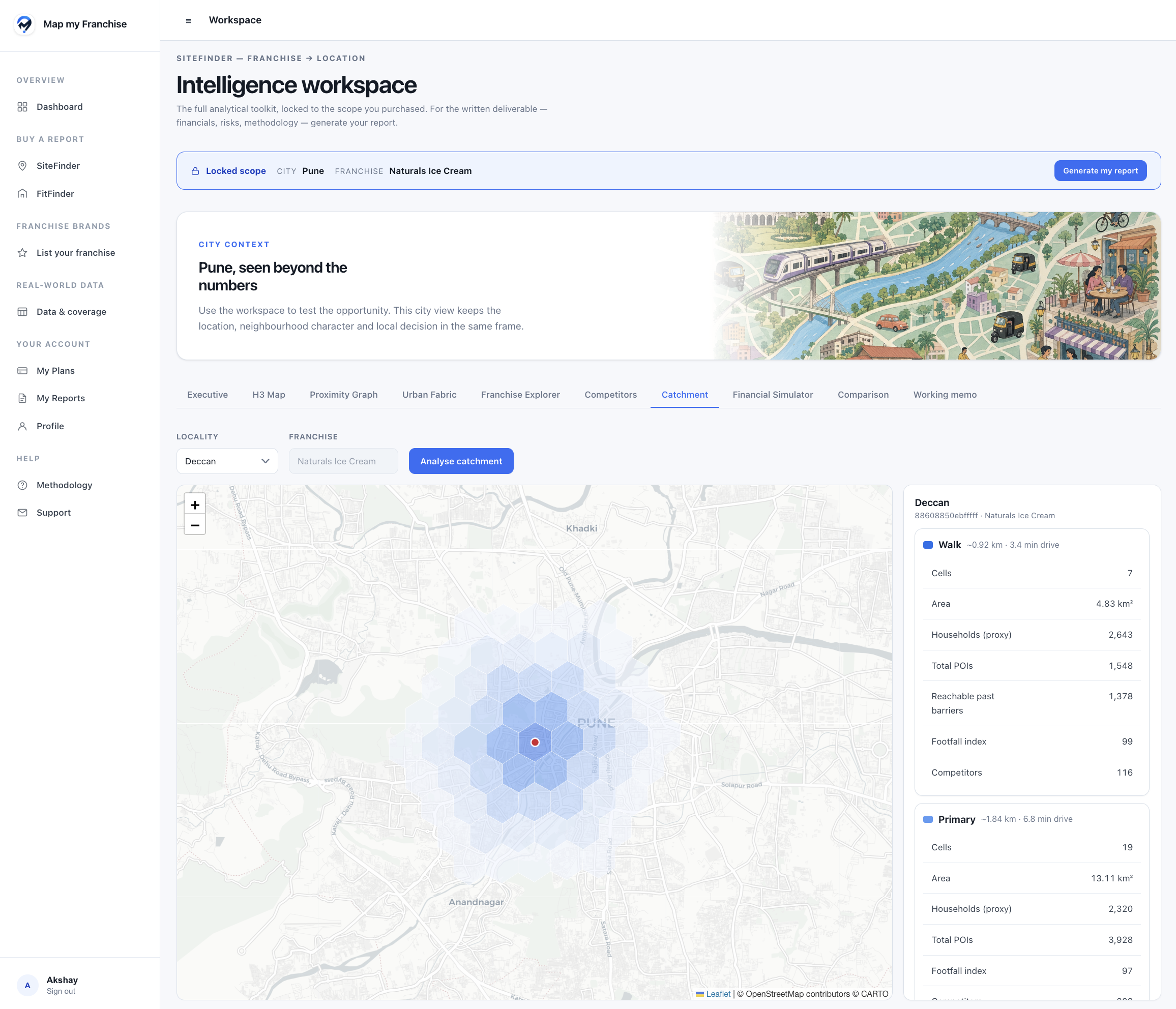
SiteFinder CatchmentActual product screen
SiteFinder catchment map around Deccan with inner and outer hexagonal bands and a household, POI and competition inspector. Original product screenshot Enlarge & inspect
Naturals Ice Cream · Deccan. These H3 catchment bands are approximate analytical areas, not road-network travel-time isochrones.
Where SiteFinder is available today
  • Open for purchase now: any city in the world. The report is delivered within 2 days of payment. Featured cities: Mumbai, New York City, Pune, Dubai, Nagpur, Gurugram, Rajkot, Copenhagen.
  • Open in Europe: every town and city — featured cities include Copenhagen.
  • BrandReach carries no city, so a brand anywhere can be listed today.
Ask about a European city

Questions this guide raises.

Do these European figures apply to my country specifically?

Only loosely. The continental totals come from federation aggregates, and the national detail here is French and British because those two federations publish the most. Germany, Spain, Italy and the Netherlands each run materially different disclosure and lease regimes; the guides on leases and disclosure set those out country by country.

Does a low franchise failure rate mean a specific unit will succeed?

No, and treating it that way is the single most expensive reading error in this sector. A sub-6% system-wide failure rate is a statement about accredited networks as a population. It says nothing about one site's catchment, its rent, or whether three competitors opened within 400 metres last year.

Sources

This guide restates published material. Where a figure matters to a decision you are about to make, read it at the source — regimes change, and a summary is only as current as the day it was written.

Statutory disclosure windows, lease regimes and competition rules differ by jurisdiction and change with legislation. Nothing on this page is legal, tax, financial or investment advice; take the documents in front of you to your own counsel.

Bring the evidence
into the decision.

See plans & pricing

Product screenshot

Read details opens at the key analysis. Scroll to explore; Actual size shows every pixel.

Original product screenshot. Example values and assumptions require verification.