
Guides India

India · Property · 4 min read

Eleven months, ten months' deposit, and no tenancy at all.

The document most Indian retail occupiers sign is not a lease. It is a licence, written to run eleven months for a reason, and it gives you far less than a European or American tenant would assume. Understand what you are actually buying before you fund the deposit.

Published · Published industry and statutory figures, restated with sources. Not legal, financial or investment advice.

  • Leave and licence
  • Security deposit
  • Stamp duty
  • Registration Act 1908
  • CAM charges

The instrument

A licence to occupy, not a right to the property.

A lease under the Transfer of Property Act, 1882 transfers an interest in the property and creates a tenancy. A leave-and-licence agreement grants permission to occupy and transfers no interest at all. Indian landlords overwhelmingly prefer the second, and the reason is recovery: a licensee has no tenancy to assert, so possession is far easier to get back, and the state Rent Control Acts that protect long-standing tenants are avoided.

The eleven-month term follows from the Registration Act, 1908. An instrument creating a tenancy of a year or more must be registered; eleven months keeps the arrangement below that threshold in the common reading, which reduces stamp duty and registration cost and keeps renewal a matter of agreement rather than right. For a franchisee this is the point that matters: a fit-out amortised over five years may sit on a document that expires in eleven months with no renewal you can enforce.

  • No tenancy, so no statutory security of tenure to fall back on
  • Renewal is negotiated each term, not a right — and escalation is negotiated with it
  • Stamp duty and registration charges vary by state and are the occupier's cost in practice
  • A fit-out outliving the agreement is the single most common mismatch

What it costs to take

The deposit is the largest cheque you write first.

Indian high-street practice runs an interest-free security deposit of several months' rent, and the engine models ten months for Indian markets — against three in the US, UK and UAE. On a unit at ₹95 per sq ft per month, the Indian tier-1 anchor the engine uses, a 1,000 sq ft shop carries roughly ₹9.5 lakh of deposit before a single rupee of fit-out. That money is locked, earns nothing, and returns only at exit.

Rent itself is quoted per square foot per *month* here, not per year as in the US, UK and UAE — a twelvefold difference that makes cross-market comparison treacherous. On top of the rent, GST at 18% applies to commercial letting, and escalation of roughly 5% a year, or 15% at each renewal, is the common pattern.

Scroll sideways to see all columns

Read from the engine's own market profiles (`retail_intelligence/spatial/market_profiles.py`), which are calibrated per market and never defaulted from one another.
MarketRent quotedDeposit modelledTax on rent
Indiaper sq ft per month10 months18% GST
United States (New York)per sq ft per year3 monthsnone
United Kingdom (London)per sq ft per year3 months20% VAT if opted to tax
UAE (Dubai)per sq ft per year3 months5% VAT

The deposit is the line most often left out of a headline investment range. It is refundable, so it is not a cost — but it is capital you cannot deploy, and it belongs in the funding plan beside the fit-out.

Organised retail

In a mall, the rent is whichever number is higher.

Mall and organised-retail terms work differently from a high-street licence. The common structure is a minimum guarantee against a percentage of revenue: you pay the greater of a fixed monthly rent or an agreed share of turnover, so the landlord takes the upside while the floor protects them on the downside.

Common area maintenance is charged separately and per square foot of chargeable area, which is larger than your carpet area — the loading factor between carpet, built-up and super built-up area is where two quotes that look comparable stop being comparable. Ask which area the rate applies to before comparing anything.

Where this platform fits

Rank the catchments before you fund the deposit.

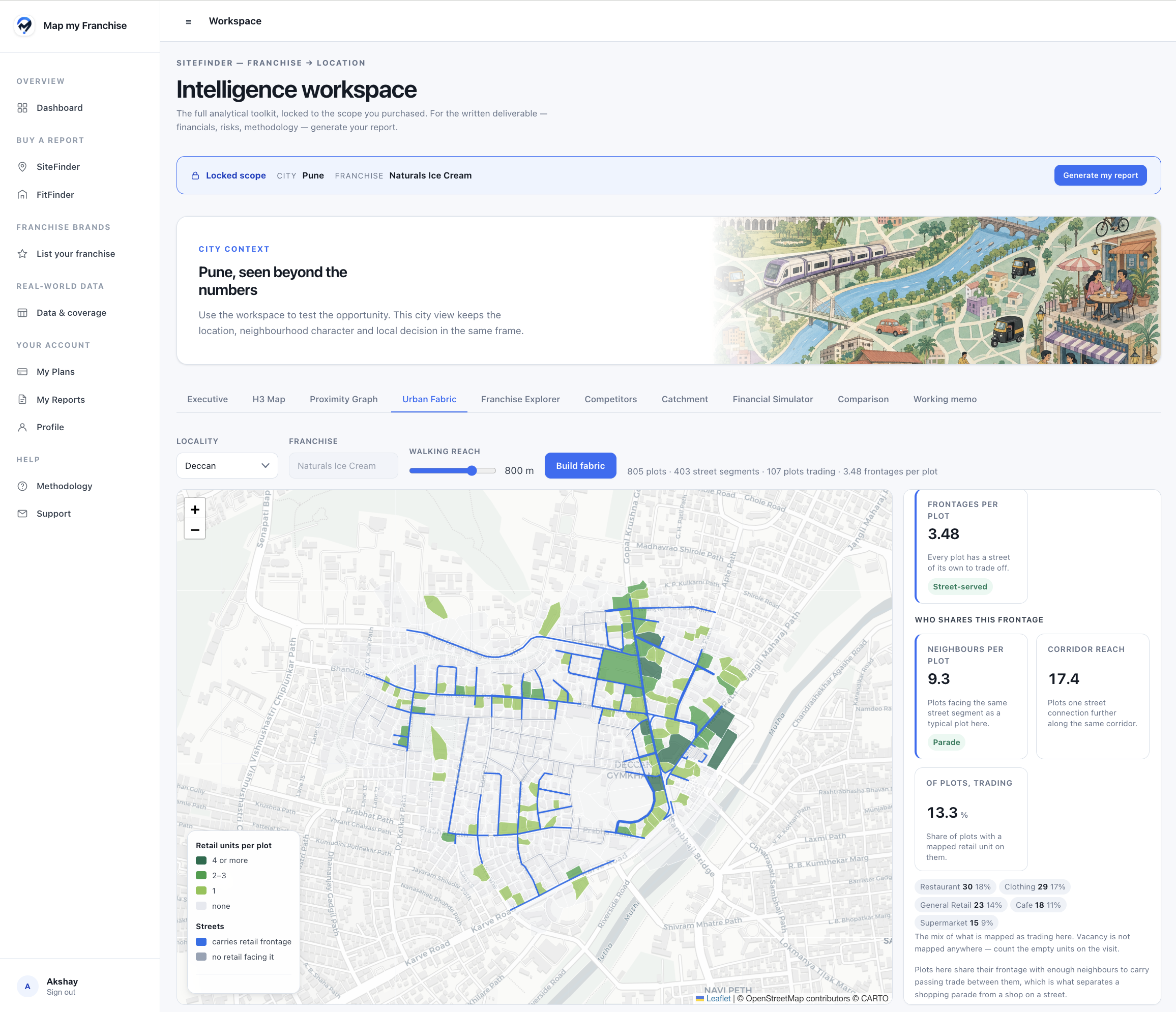
Ten months of deposit and a fit-out on an eleven-month licence is a lot of capital committed to one address. SiteFinder compares the mapped micro-markets inside one city on catchment context, competition and modelled rent, so the shortlist you take to a broker is narrowed on evidence rather than on which units happen to be free.

  • Catchment bands built from the market's own travel mode
  • Modelled market rent in ₹ per sq ft per month, the basis India actually quotes
  • The deposit modelled at the Indian norm, not borrowed from another market
  • A field-verification plan for what only a site visit settles

Carpet, built-up and chargeable area, the loading factor, the actual escalation clause and whether the document is a lease or a licence are all facts from the agreement in front of you. No analysis substitutes for reading it.

Product example · Pune, India. Check local availability below.

SiteFinder Urban fabricActual product screen
SiteFinder urban fabric map of Deccan with trading plots, street frontages and nearby retail mix. Original product screenshot Enlarge & inspect
Naturals Ice Cream · Deccan. Mapping quality varies; unmarked plots are not proof of vacancy or an absence of trade.
Where SiteFinder is available today
  • Open for purchase now: any city in the world. The report is delivered within 2 days of payment. Featured cities: Mumbai, New York City, Pune, Dubai, Nagpur, Gurugram, Rajkot, Copenhagen.
  • Open in India: every town and city — featured cities include Mumbai, Pune, Nagpur, Gurugram, Rajkot.
  • BrandReach carries no city, so a brand anywhere can be listed today.
Ask about an Indian city

Questions this guide raises.

Why is my agreement for eleven months when I need five years?

Because an instrument creating a tenancy of a year or more attracts registration under the Registration Act, 1908, and eleven months keeps a leave-and-licence below that in the common reading. If your fit-out needs five years to amortise, the renewal terms — not the initial term — are the clause to negotiate hardest.

Is the security deposit really ten months?

Ten is the high-street norm the engine models for Indian markets, against three in the US, UK and UAE. Actual practice varies widely by city, micro-market and landlord — Mumbai and Bengaluru commonly run higher than a tier-2 high street. Treat ten as the planning figure and the negotiated number as the real one.

Sources

This guide restates published material. Where a figure matters to a decision you are about to make, read it at the source — regimes change, and a summary is only as current as the day it was written.

Statutory disclosure windows, lease regimes and competition rules differ by jurisdiction and change with legislation. Nothing on this page is legal, tax, financial or investment advice; take the documents in front of you to your own counsel.

Bring the evidence
into the decision.

See plans & pricing

Product screenshot

Read details opens at the key analysis. Scroll to explore; Actual size shows every pixel.

Original product screenshot. Example values and assumptions require verification.