
Guides India

India · Compliance · 4 min read

Five licences, and none of them optional.

An Indian outlet does not open because the fit-out is finished. It opens when the registrations are in place — and they are issued by different authorities, on different timelines, several of which want the premises to exist first.

Published · Published industry and statutory figures, restated with sources. Not legal, financial or investment advice.

  • FSSAI licence
  • Shops and Establishments
  • Trade licence
  • GST registration
  • Fire NOC

The registrations

Central, state and municipal, all at once.

The registrations an outlet needs come from three levels of government and do not arrive in one place. GST registration is central and is required once turnover crosses the threshold — and in practice from the start, because a franchisee paying 18% GST on rent and royalty wants the input credit. Registration under the state Shops and Establishments Act covers employment, opening hours and weekly holidays, and is a state subject, so the form, the fee and the renewal cycle differ between Maharashtra, Karnataka and Gujarat.

The municipal layer issues the trade licence, and for anything involving food or assembly the fire NOC. Both attach to the premises rather than to you, which is why they cannot be started before site control is settled.

Scroll sideways to see all columns

Published requirements, restated for orientation. Requirements, thresholds and fees vary by state and municipality and change; confirm with a local consultant before relying on any of it.
RegistrationLevelApplies to
GST registrationCentralAny outlet over the turnover threshold, and in practice from day one
Shops and EstablishmentsStateEvery commercial premises employing staff
Trade licenceMunicipalPermission to carry on that trade at that address
FSSAI registration or licenceCentral, via stateAnything manufacturing, storing or selling food
Fire NOCState fire serviceFood premises and most assembly or larger floor plates

Food and beverage

FSSAI decides which tier you fall into.

Any business that manufactures, stores, distributes or sells food needs an FSSAI registration or licence under the Food Safety and Standards Act, and the tier depends on scale: basic registration for the smallest operators, a state licence for mid-sized ones, and a central licence for larger turnover or multi-state operation. A franchised QSR or café will normally sit in the state-licence band on a single unit.

The licence number has to appear on the premises and on packaging, and renewal is on a fixed cycle rather than open-ended. For a franchisee, the practical point is that the brand's specifications — kitchen layout, storage, water testing — are usually written to satisfy this regime, so deviating from them to save fit-out cost tends to cost the licence instead.

Order of operations

Half of these need the premises first.

The trade licence, fire NOC and FSSAI licence all attach to an address, so none of them can be completed before site control. GST and the company or LLP registration can run in parallel from the start. That ordering is what makes a wrongly chosen site expensive twice: the deposit is committed, and so is the clock on every address-bound approval.

Plan the licensing timeline against the lease commencement rather than against the opening date, and negotiate the rent-free fit-out window with the approval lead times in view rather than the construction schedule alone.

Where this platform fits

Start from the unit, and test what it can carry.

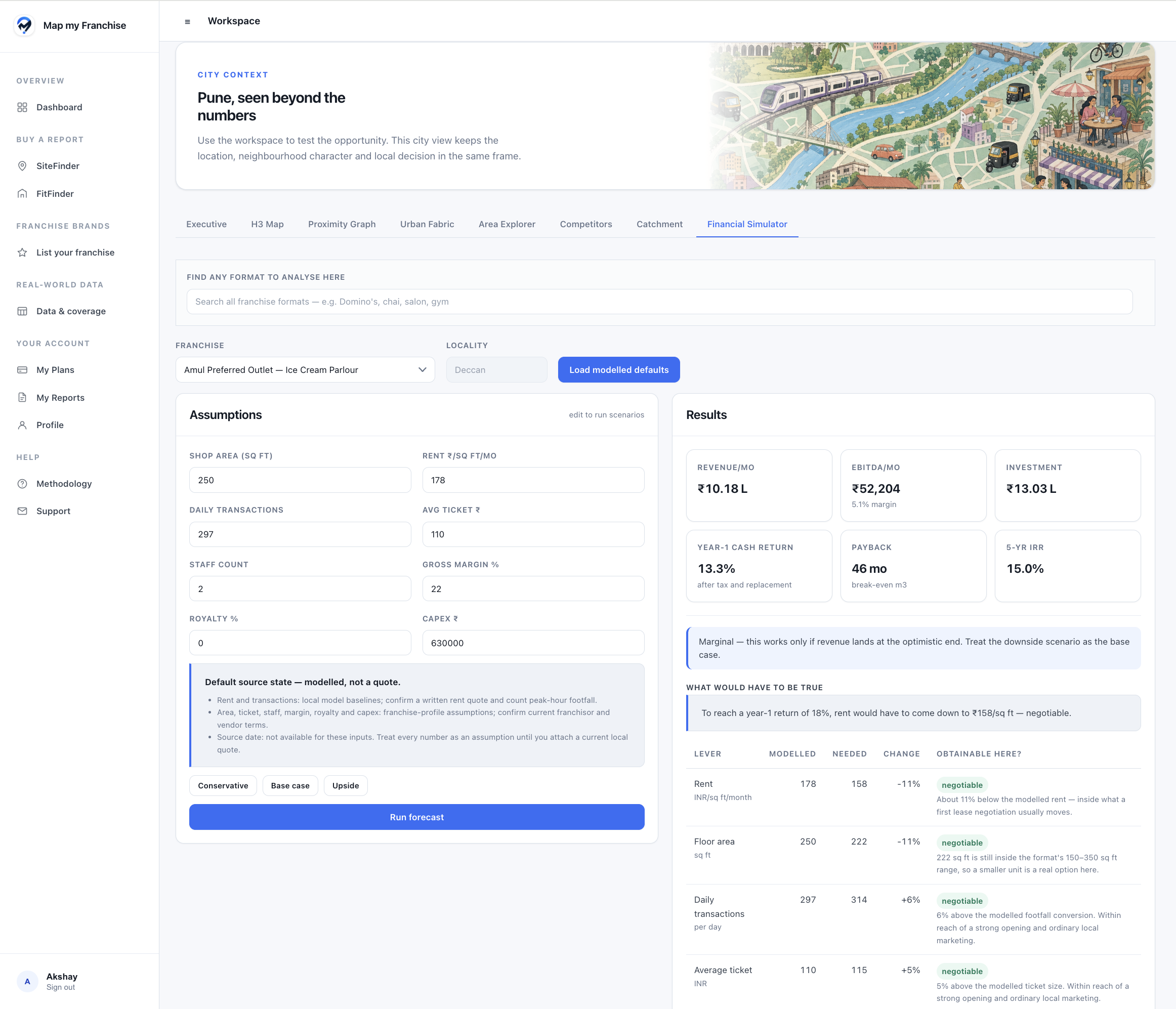
If you already hold or are being offered a property, the question reverses: not where to open but what this space supports. FitFinder reads one locked site and tests which categories and franchise formats its demand, competition and physical fabric can carry — and what a target return would require you to change.

  • Categories assessed first, brands second, against one fixed address
  • Rent, deposit, area, staffing, royalty and capex all adjustable
  • Conservative, base and upside scenarios with your budget visible
  • The gap stated plainly when nothing clears the return you need

Licensing feasibility is not modelled. Whether a particular unit can obtain a fire NOC, an extraction approval or a food licence is a question for the municipality and a local consultant, and it can disqualify a site that scores well here.

Product example · Pune, India. Modelled planning scenarios.

FitFinder Financial fitActual product screen
FitFinder financial simulator showing Amul assumptions, modelled returns and a table of rent, area and transaction changes needed to reach a target. Original product screenshot Enlarge & inspect
Amul Preferred Outlet · Deccan. The target-return calculation is a scenario, not a guarantee that the required rent or trading levels are achievable.
Where FitFinder is available today
  • Open for purchase now: any city in the world. The report is delivered within 2 days of payment. Featured cities: Mumbai, New York City, Pune, Dubai, Nagpur, Gurugram, Rajkot, Copenhagen.
  • Open in India: every town and city — featured cities include Mumbai, Pune, Nagpur, Gurugram, Rajkot.
  • BrandReach carries no city, so a brand anywhere can be listed today.
Ask about an Indian city

Questions this guide raises.

Do I need GST registration from day one?

Statutorily it is driven by turnover thresholds, which differ for goods and services and by state category. In practice most franchisees register immediately, because GST at 18% is charged on commercial rent and on the franchise royalty, and without registration that tax is a cost instead of an input credit.

Can I start the licensing before I sign for the site?

Partly. Company or LLP formation and GST registration are not address-bound in the same way, but the trade licence, fire NOC and FSSAI licence all attach to specific premises. That is why the approval lead time belongs in the rent-free fit-out window you negotiate, not in the construction plan alone.

Sources

This guide restates published material. Where a figure matters to a decision you are about to make, read it at the source — regimes change, and a summary is only as current as the day it was written.

Statutory disclosure windows, lease regimes and competition rules differ by jurisdiction and change with legislation. Nothing on this page is legal, tax, financial or investment advice; take the documents in front of you to your own counsel.

Bring the evidence
into the decision.

See plans & pricing

Product screenshot

Read details opens at the key analysis. Scroll to explore; Actual size shows every pixel.

Original product screenshot. Example values and assumptions require verification.