
Guides United States

United States · Property · 4 min read

The franchisor approves the site. You sign the lease.

In most US systems the franchisee finds the location, the franchisor's real estate committee approves it, and the franchisee signs a lease the franchisor has written itself into. Each step protects somebody. None of them is a forecast of what the unit will take.

Published · Published industry and statutory figures, restated with sources. Not legal, financial or investment advice.

  • Franchise site selection
  • Triple net lease
  • Tenant improvement allowance
  • Franchise lease rider
  • Collateral assignment of lease

Selection

A site package, then a committee.

Franchise systems increasingly select sites with geographic information systems that combine mobile-device mobility data, trade-area population density, median household income, traffic counts, access and co-tenancy with neighbouring retailers. The franchisee and a commercial broker assemble a site package from that analysis and submit it to the franchisor's real estate committee.

The committee checks the site against the brand's specifications and positioning, and against the question that matters most to the franchisor: whether it takes sales from an existing franchisee's territory. Approval means the site fits the system's rules. It is not a forecast of what the unit will take.

  • Trade-area population density and median household income
  • Mobility data and traffic counts, by time of day
  • Ingress, egress and visibility from the road
  • Co-tenancy with the retailers around the unit
  • Distance from existing franchisees' territories

Letter of intent

Base rent is only part of the negotiation.

Once a site is approved, the franchisee negotiates a letter of intent with the landlord: base rent, triple-net (NNN) charges for the landlord's taxes, insurance and common-area maintenance, renewal options, rent abatement during build-out, and the tenant improvement allowance. TI allowances commonly run from $20 to more than $100 per square foot, paid against documented construction draws once a certificate of occupancy is issued.

Published operating benchmarks put total occupancy cost at 6% to 10% of gross sales for a healthy unit. That is a ratio, so it depends on sales as much as on rent: the same lease is affordable in a strong trading area and ruinous in a weak one.

Scroll sideways to see all columns

Common commercial lease terms as described in published franchise leasing guidance. Orientation only — have a real estate attorney read the lease and the franchisor's rider before you sign either.
TermWhat it isWhy it matters
Base rentRent per square foot per year, with scheduled increasesFixed for the term, whatever the unit takes
NNN chargesYour share of property tax, insurance and common-area maintenanceCan rise during the term; ask what is capped
Rent abatementFree or reduced rent during build-outCovers months in which the unit earns nothing
TI allowanceLandlord contribution to the fit-out, commonly $20 to $100+ per sq ftReduces the capital you must finance
Renewal optionsYour right to extend on set or market termsProtects the money you put into the fit-out
Lease riderThe franchisor's notice, cure and assignment rightsUsually a condition of site approval

Lease rider

Three parties to a two-party lease.

Franchisors protect their network by requiring a franchise lease rider or a collateral assignment of lease. Under it the landlord must copy the franchisor on any default notice sent to the franchisee; the franchisor may cure a rent default; it may take over the lease and assign the premises to an approved replacement franchisee without the landlord's usual transfer penalties; and on termination its agents may enter to remove the brand's trademarks and trade dress.

Read what that does and does not do. The rider protects the franchisor's ability to keep a unit in its network. It is not written to reduce your rent or your obligations under the lease.

Then allow for the gap between signing and opening. Industry benchmarks count thousands of units sold but not yet open, held up in real estate and municipal permitting. Every month a unit waits, its franchisee spends working capital with no sales to replace it — which is why the Item 7 stress test in the FDD guide matters as much as the rent.

Where this platform fits

Rank the trading areas before a broker shows you units.

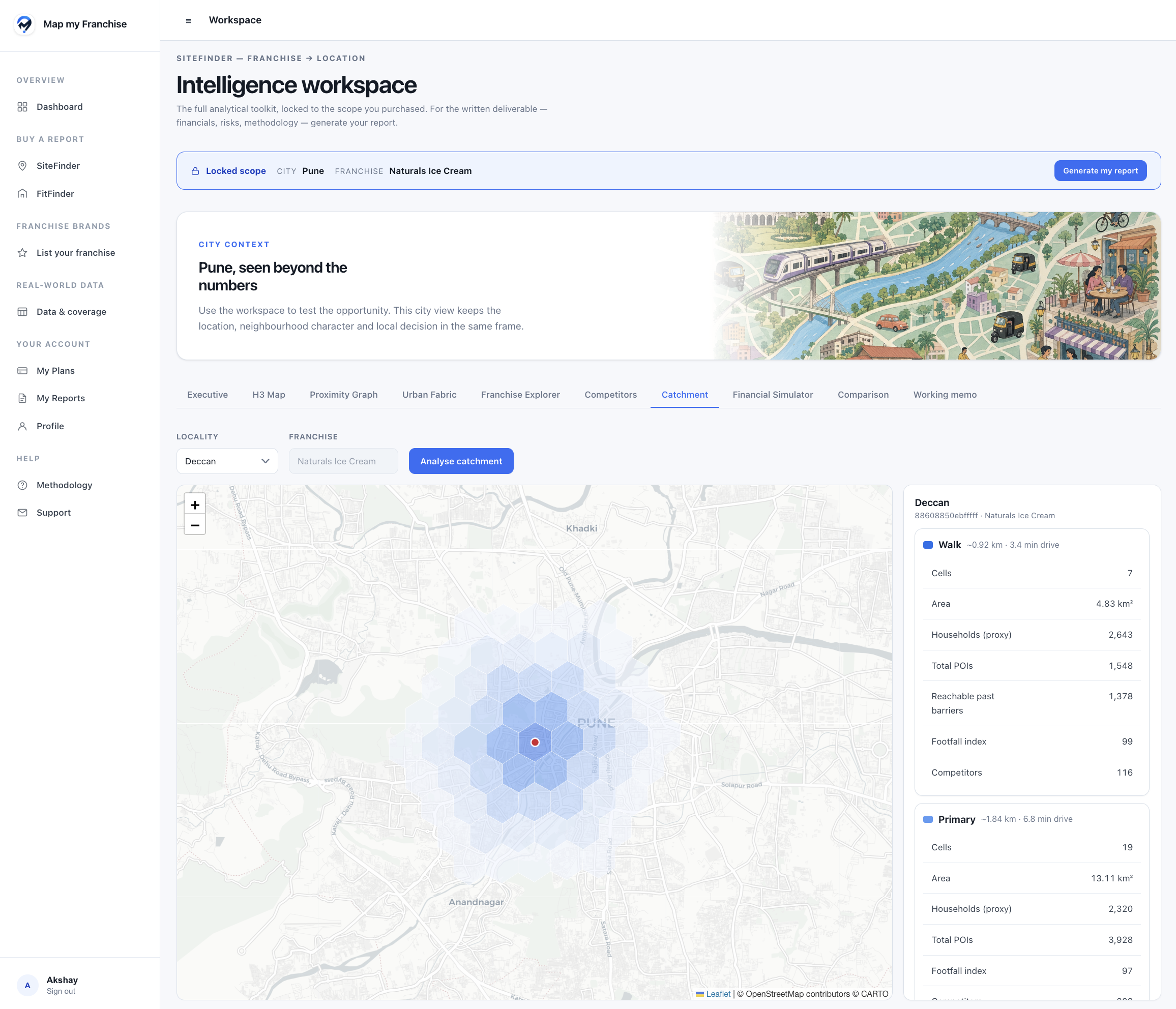
A site package is only as good as the shortlist it started from. SiteFinder compares the mapped micro-markets inside one city on catchment context, competition and modelled rent, so the areas you take to a broker and a real estate committee are already narrowed on evidence rather than on which units happen to be available.

  • Catchment bands built from the market's own travel mode, not a borrowed assumption
  • Competition and whitespace read together, so a busy street is not mistaken for an open one
  • Modelled market rent carrying its own confidence label, in the market's own quoting basis
  • A field-verification plan covering the facts a lease negotiation turns on

Catchment bands are analytical areas, not guaranteed travel times, and no analysis confirms a specific unit's frontage, access, services, zoning or lease terms. Those are site visits and legal advice, and this platform provides neither.

Product example · Pune, India. Check local availability below.

SiteFinder CatchmentActual product screen
SiteFinder catchment map around Deccan with inner and outer hexagonal bands and a household, POI and competition inspector. Original product screenshot Enlarge & inspect
Naturals Ice Cream · Deccan. These H3 catchment bands are approximate analytical areas, not road-network travel-time isochrones.
Where SiteFinder is available today
  • Open for purchase now: any city in the world. The report is delivered within 2 days of payment. Featured cities: Mumbai, New York City, Pune, Dubai, Nagpur, Gurugram, Rajkot, Copenhagen.
  • Open in United States: every town and city — featured cities include New York City.
  • BrandReach carries no city, so a brand anywhere can be listed today.
Ask about a US city

Questions this guide raises.

Does franchisor site approval mean the location will work?

No. Approval confirms that the site meets the brand's specifications and does not encroach on another franchisee's territory. It is a compliance decision by the party that collects royalties on your sales, not a forecast — and you, not the franchisor, sign the lease.

Can a location analysis replace a site visit or a broker?

No. Mapped data narrows where to look. Frontage, access, the co-tenancy on the day, the building's services, zoning and the lease terms are confirmed on the ground and in the contract, by a broker, a surveyor and a real estate attorney.

Sources

This guide restates published material. Where a figure matters to a decision you are about to make, read it at the source — regimes change, and a summary is only as current as the day it was written.

Statutory disclosure windows, lease regimes and competition rules differ by jurisdiction and change with legislation. Nothing on this page is legal, tax, financial or investment advice; take the documents in front of you to your own counsel.

Bring the evidence
into the decision.

See plans & pricing

Product screenshot

Read details opens at the key analysis. Scroll to explore; Actual size shows every pixel.

Original product screenshot. Example values and assumptions require verification.